Research

Publications

Yahya al-Wasiti, library scene, Maqamat of al-Hariri, 1237 · Bibliothèque nationale de France · public domain

New books, articles and edited volumes by AGPT scholars.

Looking for everything our scholars have written? Search the Scholars' library.

Have a new book or article out? Send us the details and we'll add it here and to our newsletter. You can also write to [email protected].

Recent

Book · 2026

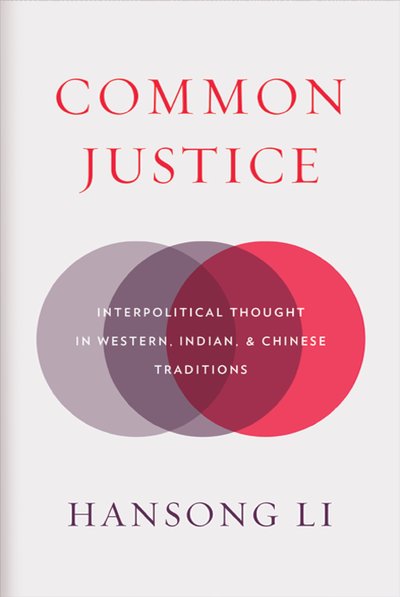
Common Justice: Interpolitical Thought in Western, Indian, and Chinese Traditions

Hansong Li · Harvard University Press

Compares interpolitical arguments in ancient Greek, Indian and classical Chinese thought, and proposes a collaborative approach to world justice. Out 15 December 2026.

“Brilliant and pathbreaking”

Pratap Bhanu Mehta, author of The Burden of Democracy

“Ranging impressively across Western, Indian, and Chinese moral and political thought, Hansong Li’s interpretation of the encounter among ancient traditions can help us reimagine possibilities for dialogue across cultural differences in our time.”

Michael Sandel, author of Democracy’s Discontent

Proceedings · 2026

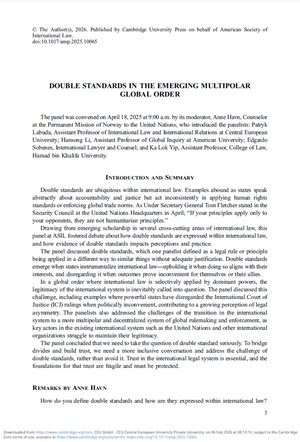
Double Standards in the Emerging Multipolar Global Order

Anne Havn, Patryk Labuda, Hansong Li, Edgardo Sobenes and Ka Lok Yip · Proceedings of the ASIL Annual Meeting

Panel at the 2025 Annual Meeting of the American Society of International Law on how double standards are expressed in international law, and what they do to trust in it.

Article · 2026

The Arctic world in Fridtjof Nansen's international thought

Hansong Li · Political Geography 127

How Fridtjof Nansen's Arctic oceanography shaped his circumpolar worldview and his later work for refugees and minorities.

Abstract

With a global oceano-political turn amid intensifying Arctic rivalries, it is prime time to reappraise polar perspectives on international politics. Taking an intellectual-historical approach, this essay explores the thought-world of the Arctic-explorer-turned High Commissioner for Refugees, Fridtjof Nansen (1861–1930). By a contextual and connective interpretation of Nansen's writings, this essay argues that the Norwegian polymath and Fram captain's Arctic oceanography informed a circumpolar worldview as an interconnected oceanic space. Moreover, Nansen mixed environmental determinism with cultural relativism into an ethical and epistemic framework, through which he defended Inuit norms against democratic domination by the forstanderskaber (local council). Finally, extending his advocacy for Greenland to other peoples and polities, especially the migrants and minorities from the Mediterranean to the Black Seas, Nansen argued against coercive state practices in favour of international movement and resettlement. In this series of argumentative moves, Nansen drew from ecology to legitimate international projects amid public humanitarian crises. Nansen's maritime international thought cautions us on the promise and peril of not only the past, but also the present rush to the unfreezing Arctic, as the once forsaken prophecy of the ‘Open Polar Sea’ gains fresh water, enabling future navigation and naval competition. Amid global displacements, by climate and by war, we have much to learn from Nansen's approach to epistemic justice and collective actions.
Article · 2022

The “Indo-Pacific”: Intellectual Origins and International Visions in Global Contexts

Hansong Li · Modern Intellectual History 19(3)

Abstract

As the “Indo-Pacific” concept gains currency in public discourses on foreign policy, it remains poorly understood as an idea, due to inadequate surveys of its intellectual origins and international visions in global contexts. This article studies Karl Haushofer’s theory of the “Indo-Pacific” as an organic and integral space primed for political consciousness. Haushofer not only laid the oceanographic foundation of the “Indo-Pacific” with novel evidence in marine sciences, ethnography, and philology, but also legitimated it as a social and political space. Mindful of Germany’s geopolitical predicament in the interwar period and informed by sources in indology and sinology, Haushofer envisaged the political resurrection of South, East, and Southeast Asia against colonial domination, and conceived the “Indo-Pacific” vision for remaking the international order.

Download the PDF · Open access (CC BY 4.0), © the author

Books

Articles

Proceedings · 2026 Double Standards in the Emerging Multipolar Global Order Anne Havn, Patryk Labuda, Hansong Li, Edgardo Sobenes, Ka Lok Yip · Proceedings of the ASIL Annual Meeting

Panel at the 2025 Annual Meeting of the American Society of International Law on how double standards are expressed in international law, and what they do to trust in it.

Article · 2026 The Arctic world in Fridtjof Nansen's international thought Hansong Li · Political Geography 127
Abstract

With a global oceano-political turn amid intensifying Arctic rivalries, it is prime time to reappraise polar perspectives on international politics. Taking an intellectual-historical approach, this essay explores the thought-world of the Arctic-explorer-turned High Commissioner for Refugees, Fridtjof Nansen (1861–1930). By a contextual and connective interpretation of Nansen's writings, this essay argues that the Norwegian polymath and Fram captain's Arctic oceanography informed a circumpolar worldview as an interconnected oceanic space. Moreover, Nansen mixed environmental determinism with cultural relativism into an ethical and epistemic framework, through which he defended Inuit norms against democratic domination by the forstanderskaber (local council). Finally, extending his advocacy for Greenland to other peoples and polities, especially the migrants and minorities from the Mediterranean to the Black Seas, Nansen argued against coercive state practices in favour of international movement and resettlement. In this series of argumentative moves, Nansen drew from ecology to legitimate international projects amid public humanitarian crises. Nansen's maritime international thought cautions us on the promise and peril of not only the past, but also the present rush to the unfreezing Arctic, as the once forsaken prophecy of the ‘Open Polar Sea’ gains fresh water, enabling future navigation and naval competition. Amid global displacements, by climate and by war, we have much to learn from Nansen's approach to epistemic justice and collective actions.
Article · 2026 Before the Godwit and the Owl: John Pocock’s Kiwi History Thomas Ashby · Australian Journal of Biography and History 12, 65–94

The first close reading of ‘Historian and Poet in New Zealand’ (1946), an essay J. G. A. Pocock wrote at 21 in reply to the essayist M. H. Holcroft and the poet Allen Curnow. Ashby shows how the…

Article · 2025 What is anticolonial and anti-imperial political thought? Yi Ning Chang · Cambridge Review of International Affairs

A review essay on three recent books: Tejas Parasher’s Radical Democracy in Modern Indian Political Thought (2023), Inés Valdez’s Democracy and Empire (2023) and Nazmul Sultan’s Waiting for the…

Article · 2022 The “Indo-Pacific”: Intellectual Origins and International Visions in Global Contexts Hansong Li · Modern Intellectual History 19(3)
Abstract

As the “Indo-Pacific” concept gains currency in public discourses on foreign policy, it remains poorly understood as an idea, due to inadequate surveys of its intellectual origins and international visions in global contexts. This article studies Karl Haushofer’s theory of the “Indo-Pacific” as an organic and integral space primed for political consciousness. Haushofer not only laid the oceanographic foundation of the “Indo-Pacific” with novel evidence in marine sciences, ethnography, and philology, but also legitimated it as a social and political space. Mindful of Germany’s geopolitical predicament in the interwar period and informed by sources in indology and sinology, Haushofer envisaged the political resurrection of South, East, and Southeast Asia against colonial domination, and conceived the “Indo-Pacific” vision for remaking the international order.

Download the PDF (open access)
Article · 2022 Timing the laws: Rousseau’s theory of development in Corsica Hansong Li · European Journal of the History of Economic Thought 29(4)
Abstract

This paper reinterprets Rousseau’s theory of political and economic development through the lens of time. In his governmental plan for Corsica, Rousseau sees an infirm political body about to heal, grow, and prosper under changing conditions, not a static experiment of autarkic agrarianism. Therefore, Rousseau’s prescriptions of a hybrid economy, intergenerational officeholding, and future-oriented defence are themselves designed to evolve over time. Rethinking Rousseau’s concept of time clarifies long-running debates over the seemingly conflicting images of the philosopher. Neither ‘founding’ nor ‘re-founding’ Corsica, Rousseau legislates in the interim, aiming for the longevity, not the immortality, of a healthy political economy.

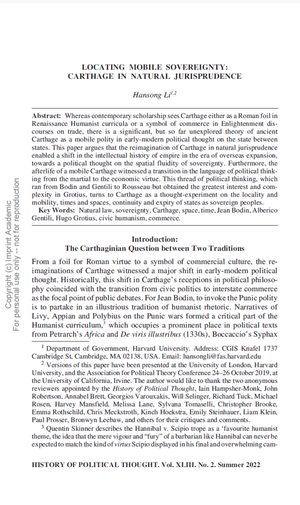
Article · 2022 Locating Mobile Sovereignty: Carthage in Natural Jurisprudence Hansong Li · History of Political Thought 43(2)
Abstract

Whereas contemporary scholarship sees Carthage either as a Roman foil in Renaissance Humanist curricula or a symbol of commerce in Enlightenment discourses on trade, there is a significant, but so far unexplored theory of ancient Carthage as a mobile polity in early-modern political thought on the state between states. This paper argues that the reimagination of Carthage in natural jurisprudence enabled a shift in the intellectual history of empire in the era of overseas expansion, towards a political thought on the spatial fluidity of sovereignty. Furthermore, the afterlife of a mobile Carthage witnessed a transition in the language of political thinking from the martial to the economic virtue. This thread of political thinking, which ran from Bodin and Gentili to Rousseau but obtained the greatest interest and complexity in Grotius, turns to Carthage as a thought-experiment on the locality and mobility, times and spaces, continuity and expiry of states as sovereign peoples.

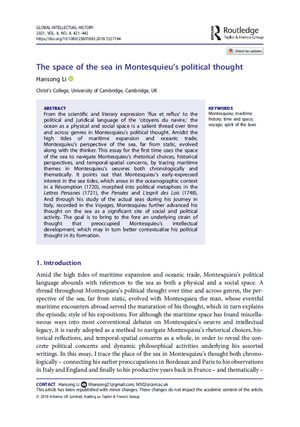
Article · 2021 The space of the sea in Montesquieu's political thought Hansong Li · Global Intellectual History 6(4)
Abstract

From the scientific and literary expression ‘flux et reflux’ to the political and juridical language of the ‘citoyens du navire,’ the ocean as a physical and social space is a salient thread over time and across genres in Montesquieu’s political thought. Amidst the high tides of maritime expansion and oceanic trade, Montesquieu’s perspective of the sea, far from static, evolved along with the thinker. This essay for the first time uses the space of the sea to navigate Montesquieu’s rhetorical choices, historical perspectives, and temporal-spatial concerns, by tracing maritime themes in Montesquieu’s oeuvres both chronologically and thematically. It points out that Montesquieu’s early-expressed interest in the sea tides, which arose in the oceanographic context in a Résomption (1720), morphed into political metaphors in the Lettres Persanes (1721), the Pensées and L’esprit des Lois (1748). And through his study of the actual seas during his journey in Italy, recorded in the Voyages, Montesquieu further advanced his thought on the sea as a significant site of social and political activity. The goal is to bring to the fore an underlying strain of thought that preoccupied Montesquieu’s intellectual development, which may in turn better contextualise his political thought in its formation.

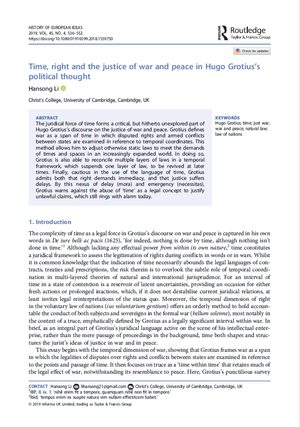
Article · 2019 Time, right and the justice of war and peace in Hugo Grotius’s political thought Hansong Li · History of European Ideas 45(4)
Abstract

The juridical force of time forms a critical, but hitherto unexplored part of Hugo Grotius’s discourse on the justice of war and peace. Grotius defines war as a span of time in which disputed rights and armed conflicts between states are examined in reference to temporal coordinates. This method allows him to adjust otherwise static laws to meet the demands of times and spaces in an increasingly expanded world. In doing so, Grotius is also able to reconcile multiple layers of laws in a temporal framework, which suspends one layer of law, to be revived at later times. Finally, cautious in the use of the language of time, Grotius admits both that right demands immediacy, and that justice suffers delays. By this nexus of delay (mora) and emergency (necessitas), Grotius warns against the abuse of ‘time’ as a legal concept to justify unlawful claims, which still rings with alarm today.

Conversations on political thought

Interviews by AGPT scholars with political theorists and historians of political thought, on how the field is done and where it is going.

Stay informed

New publications from our scholars, conference news and calls for papers, and seminar dates, once a month.